
Is Star Trek Dead?
Has the fandom succeeded in killing the franchise?

With the news that the second season of Star Trek: Starfleet Academy will be its last, the writing is on the wall for the death of the rebirth of the Trek franchise. Star Trek: Strange New Worlds is going to enter its final season, and there are no confirmed rumors of any Trek production to follow. The theatrical movie side of the franchise effectively met its end with Star Trek Beyond (2016). What happens next?
The end was written before the beginning of the rebirth era. When Viacom (parent company of Paramount) split from CBS in 2005, it split Trek into separate entities for movie and TV production. This split remained in place until 2019 when the companies merged again. In the meantime, we had the 2009 film Star Trek (establishing the Kelvin timeline), followed by Star Trek Into Darkness (2013) and Star Trek Beyond. The TV series Star Trek: Discovery (2017) launched on CBS while both companies holding rights to the Trek franchise were still split, meaning there were aspects of the franchise that couldn’t be used because the show was produced by CBS, while Paramount also held some of the rights. Even the starship Enterprise had to be modified slightly so it wouldn’t infringe on Paramount’s rights.
Although many in the Trek fandom hated the Kelvin timeline movies, they truly hated Star Trek: Discovery (Disco) from the start. They quickly proclaimed it as not being their Trek, especially with the redesign of the Klingons from the Star Trek: The Next Generation (TNG) era. Disco was the first series of the rebirth era, coming after the 2005 cancellation of Star Trek: Enterprise. This rebirth era comprises Disco, Star Trek: Strange New Worlds, Star Trek: Prodigy, Star Trek: Picard, Star Trek: Lower Decks, Star Trek: Starfleet Academy (SFA), and the Star Trek: Section 31 movie. Paramount pumped over $2 billion into the franchise’s rebirth, with little to show for it.
It wasn’t that the money Paramount spent made for bad episodes of Star Trek. I would argue that some of the very best episodes of the entire Trek franchise happen during the rebirth era. The problem is that these were not the shows a vocal minority of the franchise wanted to see. A lot of Gen X and Millennial love exists for the TNG era of the franchise, and a vocal minority of fans came into the rebirth era expecting a continuation of it, which is not what they got. The TNG era, in my opinion, can best be described in a few key ways. As far as cinematography goes, the shows were all brightly lit. Although this was done to overcome the cameras’ limitations, it is a shooting style that stands out. The TNG era shows were mostly episodic. The story began and ended within the episode, and what happened in last week’s episode had little to no effect on what happened in this week’s episode. The TNG era typically featured simple episodes that didn’t require viewers to pay close attention. The show could play in the background while the viewer did other stuff. Everything was telegraphed in dialogue, so the viewer didn’t have to watch the screen to know what was going on. Specifically, Star Trek: The Next Generation stands out from the other TNG-era shows (Star Trek: Deep Space Nine (DS9) and Star Trek: Voyager (VOY)) because White males were clearly in charge. I mention that because DS9 had a Black male lead and women in leadership roles, and VOY had a woman as captain, and both shows were considerably less popular than TNG. We can’t discount racism and sexism in the fandom.
In the rebirth era, we got Star Trek TV shows shot in a cinematic style. The brightly-lit aesthetic of the TNG era was gone. We had a lot of dark scenes, because newer camera tech didn’t require bright lights to capture a decent image. The rebirth era shows were mostly serialized, telling one story over the course of the season. This meant that the events of one episode play heavily into what happens in the following episode. It also meant that the viewer needed to pay attention and remember details that could be relevant later. Many of the rebirth episodes showed the story instead of telling it, meaning the characters might not speak about what they were doing, which forced the viewer to look at the screen to follow the story. These episodes could not be played in the background because the viewer might miss something relevant to the ongoing story. Specifically, Star Trek: Discovery saw a Trek show centered around a Black woman, with plenty of other women in key roles. For as much as Star Trek fans want to embrace IDIC (Infinite Diversity in Infinite Combinations), and will point out how Gene Roddenberry’s original show took bold steps in casting and storytelling, some Trek fans are racist and sexist, and Disco was particularly problematic for them.
The rebirth era of Trek also faced a challenge with Star Trek: Picard. Many fans went into it thinking it would be a continuation of the TNG era. They were not emotionally prepared for a deeply troubled, damaged, retired Admiral Picard. This was not the dude they signed up to see. For this reason, we got a third season of the show, which was fan service for TNG lovers. They wanted their Trek back, so that’s what they were given. It’s a shame, because the second season was headed in a direction I wanted to see explored.
We have two flavors of animation in the rebirth era, Star Trek: Prodigy, and Star Trek: Lower Decks. The first was largely ignored and the second was hit-or-miss. Star Trek: Prodigy is the show that was meant for kids. It ran on Nickelodeon and was intended to introduce concepts of the Trek universe to younger viewers, starting around 7 years old. As such, it told a straightforward story that young viewers could follow. I thought it told that story quite well. I truly think if you have young kids you’d like to introduce to the Trek franchise without boring them to tears or baffling them with technobabble, you can’t go wrong with using Star Trek: Prodigy as the gateway drug. Star Trek: Lower Decks, however, is definitely not for kids. If you’re steeped in Trek lore and like a dose of irreverence with your Trek, Star Trek: Lower Decks scratches that itch. Some fans loved it. Some fans hated it. Proceed with caution.
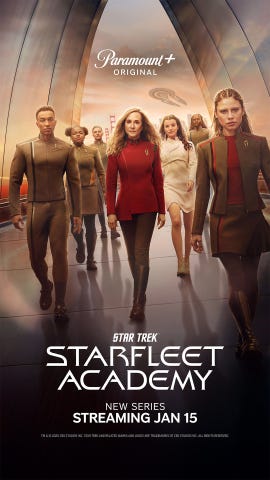
Star Trek: Starfleet Academy is the latest and final addition to the franchise. It exists in the same universe as Disco, meaning that it references events from Disco and includes cast members from that show. It involves a much younger primary cast than we’re used to seeing, and it has women in leadership roles. I’m sure you know where I’m going with this. It’s not the Trek that TNG-era fans wanted. It’s serialized. It’s emotional. The show lead isn’t a White male. This is all problematic for certain viewers. On the other hand, it’s a damn good story. The first season gave us new characters and made us care about them and what happened to them. A lot of Trek shows failed to give us a reason to care about the characters, they were just cardboard cutouts serving a role.
As of this writing, there are no confirmed rumors of any new shows in the Trek franchise. There’s talk, but I won’t believe anything is happening until the ink is dry on the contracts. On the movie side of things, there’s even less talk. I honestly don’t think we will see another Trek theatrical release for the remainder of this decade. The franchise, at least as far as TV and movie production goes, is dead after the second season of SFA airs. The franchise lives on in novels and fan productions, but it’s not the same.